Hello! now
 +8619886240609(Bella)
+8619886240609(Bella)
 My Account


Capacitor Fundamentals and Selection Guide: A Comprehensive Analysis of Working Principles, Types, and Applications
7/17/2026 2:50:42 AM
One of the most widely used and indispensable passive components in modern electronic devices is the capacitor. From smartphones, computers and automotive electronics, to industrial control, medical equipment and new energy systems, almost all electronic products cannot do without capacitors. Although it is small in size, it plays a crucial role in energy storage, filtering, coupling, decoupling, timing and signal processing.
The capacitance of a capacitor is usually expressed in farads (F), and common units in practical applications include: pF, nF, μF, mF.
Main functions include: filtering, decoupling, coupling, energy storage, timing and oscillation.
During the discharge process:
The demand for capacitance varies in different application scenarios:
Decoupling capacitors usually choose:
In practical applications, a certain voltage margin should be reserved. Generally, for industrial products, the working voltage is recommended not to exceed 70% to 80% of the rated voltage. For automotive electronics and high-reliability equipment, it is recommended to control within 50% to 70%. For example:
Common dielectrics include:
The lower the ESR, the better the filtering effect, less heat generation, and superior high-frequency performance.
In high-speed circuits such as DC/DC power supplies, CPU power supplies, and AI servers, low ESR capacitors should be preferred.
For high-frequency applications:
Common MLCC packages include: 0201
An excessively large capacitance not only increases the cost but may also cause a larger startup surge current, and even affect the system startup.
2. Is it sufficient if the rated voltage is just enough?
Working at the full rated voltage for a long time will accelerate the aging of the capacitor. It is recommended to maintain an appropriate margin.
3. Can the DC bias effect be ignored?
After applying a DC voltage to ceramic capacitors, their actual capacity may significantly decrease, especially for high capacitance and small-sized MLCCs. Therefore, when designing, one should refer to the DC bias curves provided by the manufacturers.
4. Can ESR and ESL be ignored?
In high-frequency applications, focusing solely on capacity while neglecting ESR and ESL may result in poor filtering performance.
5. What are the influencing factors during capacitor operation?
What is a capacitor?
A capacitor is an electronic component that can store electric charge and electrical energy. Its basic structure consists of two conductive electrodes and an insulating medium in the middle. When a voltage is applied across the capacitor, electric charges will accumulate on each electrode respectively, forming an electric field and storing energy.The capacitance of a capacitor is usually expressed in farads (F), and common units in practical applications include: pF, nF, μF, mF.
Main functions include: filtering, decoupling, coupling, energy storage, timing and oscillation.
- Filtering: In power supply circuits, capacitors can effectively reduce voltage ripple, making the output voltage more stable, and providing a stable power supply for chips such as CPUs, MCUs, and FPGAs.
- Decoupling: When high-speed digital chips are operating, they generate instantaneous current changes. Decoupling capacitors can quickly provide instantaneous current, absorb power supply noise, and improve system stability.
- Coupling: Coupling capacitors are used to isolate DC signals and only allow AC signals to pass through, mainly used in audio equipment, communication equipment, and analog signal processing.
- Energy storage: Some capacitors can charge and discharge quickly.
- Timing and oscillation: RC circuits utilize the charging and discharging characteristics of capacitors to achieve delay control, clock generation, oscillators, and PWM control.
The working principle of a capacitor
1. Storage of electric charge
When a capacitor is connected to a DC power supply, electrons start to move:- The negative terminal of the power supply continuously provides electrons to one side of the capacitor, causing that plate to become negatively charged.
- At the same time, electrons on the other side of the plate are attracted by the positive terminal of the power supply and become positively charged.
- Due to the presence of an insulating medium between the two plates, electrons cannot directly pass through, thus forming a stable electric field.
2. Charging process
- When the capacitor is just connected to the power supply: the voltage is 0V, the current reaches its maximum value, and the charge accumulates rapidly.
- As charging continues: the capacitor voltage keeps increasing, the current gradually decreases, and eventually approaches zero.
3. Discharging process
When the power supply is disconnected and the capacitor is connected to the load, the energy stored in the electric field begins to be released. Electrons flow from the negative plate to the external circuit and then return to the positive plate, forming a discharge current.During the discharge process:
- The voltage gradually decreases;
- The current gradually decreases;
- The electric field gradually disappears;
- Finally, the capacitor returns to an uncharged state.
- The discharge speed is also affected by the RC time constant.
Parameters to be considered for capacitor selection
1. Capacitance
Capacitance is the primary parameter to consider during selection. Its units are typically pF, nF, μF, or mF.The demand for capacitance varies in different application scenarios:
Decoupling capacitors usually choose:
- 0.01 μF
- 0.1 μF
- 1 μF
- Filtering capacitors: Select from tens of microfarads to hundreds of microfarads based on the output ripple requirements. The power input end may even require thousands of microfarads.
- Energy storage applications: For UPS, motor drives, etc., larger electrolytic capacitors or supercapacitors are required.
2. Rated Voltage
Rated voltage indicates the highest voltage that the capacitor can work safely for a long time.In practical applications, a certain voltage margin should be reserved. Generally, for industrial products, the working voltage is recommended not to exceed 70% to 80% of the rated voltage. For automotive electronics and high-reliability equipment, it is recommended to control within 50% to 70%. For example:
- For the 12V system, 16V or 25V capacitors can be selected.
- For the 24V system, 35V or 50V capacitors are recommended.
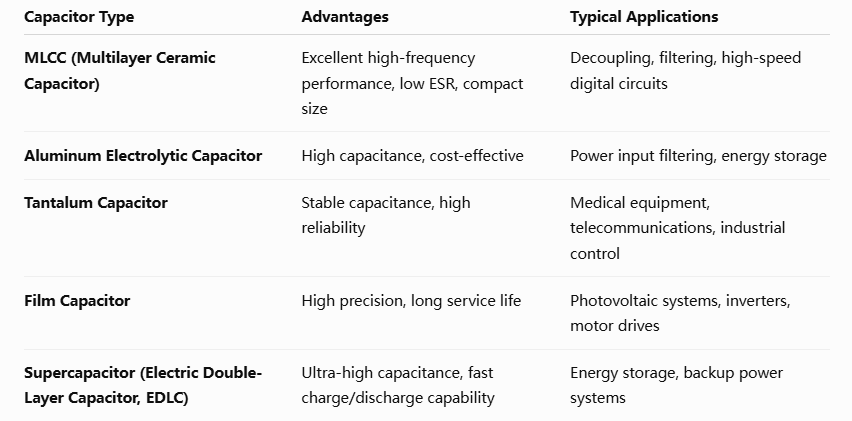
3. Capacitor types
Different types of capacitors have different characteristics. They should be selected based on application requirements.
4. Temperature Characteristics
For MLCCs, the dielectric material directly determines the stability of the capacitance.Common dielectrics include:
- C0G (NP0): The capacity variation is minimal, and the high-frequency performance is excellent, with high precision.
- X7R: Balanced overall performance, the most widely used.
- X5R: Higher capacity, suitable for general industrial and consumer electronic products, but the capacity stability is slightly inferior to X7R when the temperature changes significantly.
- Y5V: Although the capacity is large, it is significantly affected by temperature and voltage, and is not recommended for scenarios requiring high stability.
5. ESR (Equivalent Series Resistance)
ESR is an important indicator for measuring the performance of capacitors.The lower the ESR, the better the filtering effect, less heat generation, and superior high-frequency performance.
In high-speed circuits such as DC/DC power supplies, CPU power supplies, and AI servers, low ESR capacitors should be preferred.
6. Frequency Characteristics
The impedance of capacitors changes at different frequencies.For high-frequency applications:
- MLCCs should be preferred.
- Note the impact of ESL (Equivalent Series Inductance) on performance.
- Aluminum electrolytic capacitors or film capacitors can be used.
7. Package Size
Package size affects PCB layout, heat dissipation, and mechanical reliability.Common MLCC packages include: 0201
- 0402
- 0603
- 0805
- 1206
- 1210
8. Working Environment
In practical applications, the following factors should also be taken into consideration:- Working temperature range
- Humidity Vibration
- Impact
- Service life
- Whether it complies with AEC-Q200 and other automotive industry standards
Selection Suggestions
During the actual design process, the selection can be carried out according to the following steps:- Clarify the application scenario (filtering, decoupling, coupling or energy storage).
- Determine the required capacitance and allowable error.
- Select the appropriate rated voltage based on the working voltage and reserve a safety margin.
- Choose the appropriate capacitor type according to the frequency characteristics.
- Select the dielectric and packaging based on the temperature range, mechanical environment and life requirements.
- Verify the parameters such as ESR, ESL and DC bias to ensure they meet the system performance requirements.
- Prioritize choosing reliable brands and stable supply channels to ensure product consistency and long-term supply capability.
Summary
The core working principle of a capacitor is to store and release energy through the electric field formed between two conductors. During charging, an electric field is established; during discharging, the energy of the electric field is released. Thus, it can achieve various functions such as energy storage, filtering, decoupling, coupling, and signal processing. Although capacitors are small, they directly affect the performance, stability, and reliability of electronic products. Scientific capacitor selection requires comprehensive consideration of capacity, rated voltage, dielectric material, ESR, frequency characteristics, package size, and application environment, rather than focusing solely on a single parameter.
Q&A
1.Is it true that the larger the capacitance, the better?An excessively large capacitance not only increases the cost but may also cause a larger startup surge current, and even affect the system startup.
2. Is it sufficient if the rated voltage is just enough?
Working at the full rated voltage for a long time will accelerate the aging of the capacitor. It is recommended to maintain an appropriate margin.
3. Can the DC bias effect be ignored?
After applying a DC voltage to ceramic capacitors, their actual capacity may significantly decrease, especially for high capacitance and small-sized MLCCs. Therefore, when designing, one should refer to the DC bias curves provided by the manufacturers.
4. Can ESR and ESL be ignored?
In high-frequency applications, focusing solely on capacity while neglecting ESR and ESL may result in poor filtering performance.
5. What are the influencing factors during capacitor operation?
- Dielectric material: It determines the stability of capacity, withstand voltage and loss.
- Temperature: High temperature can cause changes in the capacity of some capacitors and even shorten their service life.
- Operating frequency: The higher the frequency, the higher the requirements for the ESR (equivalent series resistance) and ESL (equivalent series inductance) of the capacitor.
- Rated voltage: It is recommended that the long-term operating voltage be lower than the rated voltage to improve reliability.
- Aging effect: Some ceramic capacitors will experience capacity attenuation over time, which needs to be taken into account in precise circuits.
Related information


- Fast Shipping Fast and convenient door to door delivery.

- Paypment Security More than 5 different secure payment methods.

- Strictly Quality Control 365 days After-Sales Service and Warranty

- Simple And Professional One-stop Electronics Procurement Solutions.