Hello! now
 +8619886240609(Bella)
+8619886240609(Bella)
 My Account


TLVR and TDK HPL1005: Solving the Power Supply Problem for 1000W AI GPUs
6/5/2026 3:04:28 AM
With the rapid proliferation of generative AI, large model training, and high-density GPU clusters, hardware engineers are gradually abandoning the traditional voltage regulation module (VRM). The power consumption of AI servers has rapidly shifted from the traditional range of 300W to 500W to a time when a single GPU exceeds 1000W. New-generation AI acceleration cards and data center GPUs pose unprecedented challenges to the power supply system:
There are several core bottlenecks in traditional multi-phase Buck VRM:
1. Insufficient current response speed
Traditional multi-phase VR relies on sequential phase activation for current compensation. One phase responds first, and the remaining phases follow later, resulting in a significant response delay. This can cause voltage sag, GPU instability, AI training errors, and system power loss.
2. Huge losses due to high frequency
To improve response speed, traditional solutions can only increase the switching frequency and the number of phases. If the inductance value is reduced to increase speed, it will generate severe ripple current and heat dissipation problems. If the number of phases is increased to disperse heat, it will occupy a large amount of circuit board space. Especially in high-density AI motherboards such as OAM and HGX, the PCB area is already very tight.
Advantages:
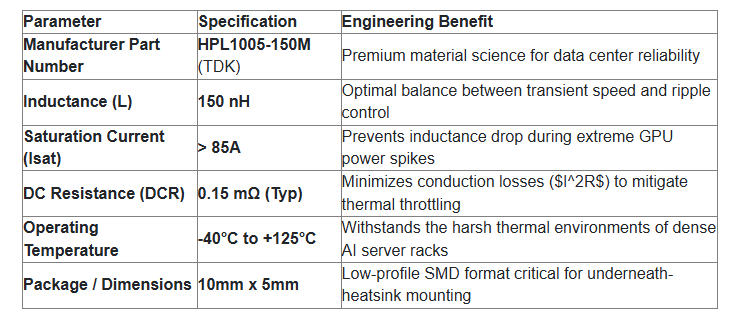
The ultra-low DCR of HPL1005 can significantly reduce: conduction loss, thermal accumulation, VRM temperature rise.
2. Ultra-high Isat (saturated current)
The >85A saturation capability of HPL1005 can support the extreme load shock of AI GPUs.
3. Optimized for TLVR
TLVR has extremely high requirements for magnetic coupling: winding consistency, high-frequency characteristics, coupling stability. HPL1005 is specifically designed for AI Servers, HGX motherboards, OAM power supplies and GPU Core Rails.
The industry is facing shortages of high-end magnetic components, long lead times, large-scale lock-in orders, and early stock preparation for data centers. Especially for 100nH to 220nH TLVR inductors, ultra-low DCR inductors, and high Isat magnetic components, the demand is growing very rapidly.
From the purchasing perspective: The usage of TLVR components for a single GPU reaches more than 24 pieces, and the overall BOM material ratio is high, and the risk of spot purchasing is uncontrollable. It is recommended to lock in a 12-month forward supply contract for the TDK HPL series and rely on long-term purchase quotas to ensure the synchronization of material entry.
Alternative solution: If the delivery cycle of TDK HPL1005-150M is extended, the engineering team should evaluate the following cross-references to determine its functional equivalence (note: the pad layout must be verified to ensure complete size matching):
- Ultra-low voltage (<1V)
- Ultra-large current (1000A+)
- Extremely high load transient (High di/dt)
- Extremely small voltage tolerance (±30mV or less)
The traditional multi-phase VRM architecture has gradually become unable to meet the transient power supply requirements of AI servers. Therefore, the TLVR architecture has begun to become the mainstream power supply solution for AI servers.
Market and Technology Background: Why Traditional VRM Fails in the Face of AI GPUs
The scale of modern generative AI clusters has pushed the thermal limit of silicon chips to the extreme. The load on AI GPUs varies extremely rapidly, and the current of the GPU may need to jump from several hundred amperes to several thousand amperes in just a few nanoseconds.There are several core bottlenecks in traditional multi-phase Buck VRM:
1. Insufficient current response speed
Traditional multi-phase VR relies on sequential phase activation for current compensation. One phase responds first, and the remaining phases follow later, resulting in a significant response delay. This can cause voltage sag, GPU instability, AI training errors, and system power loss.
2. Huge losses due to high frequency
To improve response speed, traditional solutions can only increase the switching frequency and the number of phases. If the inductance value is reduced to increase speed, it will generate severe ripple current and heat dissipation problems. If the number of phases is increased to disperse heat, it will occupy a large amount of circuit board space. Especially in high-density AI motherboards such as OAM and HGX, the PCB area is already very tight.
The TLVR architecture seems to have become the new standard for AI servers.
TLVR essentially involves adding coupling windings to the traditional multi-phase inductor to achieve synchronous transient response for all phases. Moreover, TLVR enables all phases to be powered simultaneously, thereby significantly improving the transient performance of the load.Advantages:
- Synchronous response for all phases
- Significant reduction in output capacitance
- More suitable for 1000W+ GPUs
In-depth Analysis of TDK HPL1005: AI Server TLVR Inductor Solution
In the TLVR architecture, the inductor is no longer a common passive component but the core of the entire AI power supply system. The TDK HPL1005 series, especially HPL1005-150M, is becoming an important solution for the high-end power supply of AI servers. As a benchmark product for enterprise-level computing components, it is compatible with high-current multi-phase VRM design, with low DCR and high saturation current, and can work stably and effectively in the AI full-load inference environment.
Main features
Why is HPL1005 suitable for AI GPUs?
1. Extremely low DCRThe ultra-low DCR of HPL1005 can significantly reduce: conduction loss, thermal accumulation, VRM temperature rise.
2. Ultra-high Isat (saturated current)
The >85A saturation capability of HPL1005 can support the extreme load shock of AI GPUs.
3. Optimized for TLVR
TLVR has extremely high requirements for magnetic coupling: winding consistency, high-frequency characteristics, coupling stability. HPL1005 is specifically designed for AI Servers, HGX motherboards, OAM power supplies and GPU Core Rails.
AI Server Magnetic Component Supply Chain Insight and Cross-Reference Solution
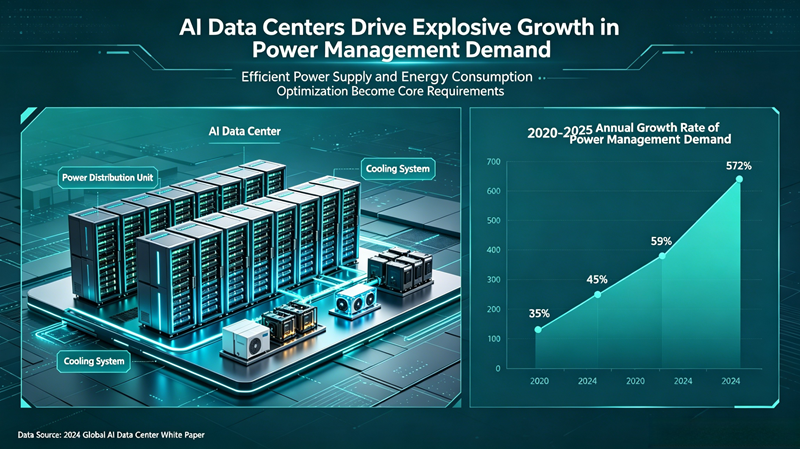
With the explosion of AI data centers, the construction of ultra-large-scale clouds has imposed tremendous pressure on the passive component supply chain, especially for high-current TLVR magnetic components.The industry is facing shortages of high-end magnetic components, long lead times, large-scale lock-in orders, and early stock preparation for data centers. Especially for 100nH to 220nH TLVR inductors, ultra-low DCR inductors, and high Isat magnetic components, the demand is growing very rapidly.
From the purchasing perspective: The usage of TLVR components for a single GPU reaches more than 24 pieces, and the overall BOM material ratio is high, and the risk of spot purchasing is uncontrollable. It is recommended to lock in a 12-month forward supply contract for the TDK HPL series and rely on long-term purchase quotas to ensure the synchronization of material entry.
Alternative solution: If the delivery cycle of TDK HPL1005-150M is extended, the engineering team should evaluate the following cross-references to determine its functional equivalence (note: the pad layout must be verified to ensure complete size matching):
- Eaton: FP1008R3-R150-R (150nH, ultra-low DC resistance, server grade)
- Bourns: TLVR1005T-150M (150nH, dedicated TLVR secondary winding)
Conclusion
In the era of 1000W+ GPUs, it is essentially a revolution in the power architecture of AI. Adopting the TLVR architecture is no longer an optional feature but a necessary condition for supporting a thermal design power (TDP) of over 1000W. Under this trend, high-performance TLVR inductors such as TDK HPL1005 will become key core components in the power supply systems of AI GPUs, data centers, HGX/OAM platforms, and next-generation AI accelerators. The future competition in AI computing power is not only a competition among GPUs, but also a competition between power architectures and magnetic components.Related information

- Fast Shipping Fast and convenient door to door delivery.

- Paypment Security More than 5 different secure payment methods.

- Strictly Quality Control 365 days After-Sales Service and Warranty

- Simple And Professional One-stop Electronics Procurement Solutions.