Hello! now
 +8619886240609(Bella)
+8619886240609(Bella)
 My Account


Fuse: The First Line of Defense for Safe Operation of Electronic Devices
6/22/2026 2:19:33 AM
In modern electronic devices, the power density of electronic equipment is constantly increasing, and the probability of short circuits, overloads, and power supply abnormalities occurring is also increasing. If the current exceeds the design range, it can even exacerbate the risks of PCB line burning, component damage, and fire. Therefore, circuit protection is of utmost importance. Among various protection components, the fuse, which has a simple structure, high reliability, and low cost, has always been one of the basic and most effective overcurrent protection solutions.
The function of a fuse is to cut off the circuit before a danger occurs. When the current exceeds the rated value of the fuse and persists for a period of time, the internal fuse element heats up and melts, and quickly disconnects the circuit to prevent the fault from further expanding. It becomes the most economical and reliable "safety guard" in electronic systems.
It is a simple and effective mechanism that makes the fuse one of the most widely used circuit protection components in the world.
It can cut off the abnormal power supply in an extremely short time.
Applicable to: semiconductor devices, IC chips, communication equipment, precision instruments
Because these devices are usually very sensitive to overcurrent and require fuses to quickly cut off the power supply to avoid damage.
2. Slow-acting fuse
The slow-acting fuse can withstand short-term surge currents without melting.
Applicable to: switching power supplies, motor drives, transformers, LED lighting
Because these devices generate a large instantaneous current when starting, the slow-acting fuse can avoid melting.
3. Surface mount fuse
SMD fuse is suitable for miniaturized electronic products.
Features include: small size, automated soldering production, fast response, high reliability
Applied to: smart phones, tablets, wearable devices
4. High-voltage high-current fuse
High-voltage high-current fuse has higher breaking capacity and stronger safety performance.
Applicable to: new energy vehicles, energy storage systems, photovoltaic inverters, AI server power supplies
The function of a fuse is to cut off the circuit before a danger occurs. When the current exceeds the rated value of the fuse and persists for a period of time, the internal fuse element heats up and melts, and quickly disconnects the circuit to prevent the fault from further expanding. It becomes the most economical and reliable "safety guard" in electronic systems.
How a fuse works
A fuse is mainly composed of a fuse element, a housing, and a terminal cap. During normal operation, the current passing through the fuse element does not generate excessive heat. However, when there is a circuit short circuit, equipment overload, component failure, or power supply abnormality, the current flowing through the fuse rapidly increases, the fuse element temperature rises and reaches the melting point, and eventually melts and cuts off the circuit. This is based on the Joule heating effect: Q = I2Rt. The greater the current, the more heat is generated, and the faster the fuse melts.It is a simple and effective mechanism that makes the fuse one of the most widely used circuit protection components in the world.
Main classifications of fuses
1. Fast-acting fuseIt can cut off the abnormal power supply in an extremely short time.
Applicable to: semiconductor devices, IC chips, communication equipment, precision instruments
Because these devices are usually very sensitive to overcurrent and require fuses to quickly cut off the power supply to avoid damage.
2. Slow-acting fuse
The slow-acting fuse can withstand short-term surge currents without melting.
Applicable to: switching power supplies, motor drives, transformers, LED lighting
Because these devices generate a large instantaneous current when starting, the slow-acting fuse can avoid melting.
3. Surface mount fuse
SMD fuse is suitable for miniaturized electronic products.
Features include: small size, automated soldering production, fast response, high reliability
Applied to: smart phones, tablets, wearable devices
4. High-voltage high-current fuse
High-voltage high-current fuse has higher breaking capacity and stronger safety performance.
Applicable to: new energy vehicles, energy storage systems, photovoltaic inverters, AI server power supplies
The selection principle of fuses
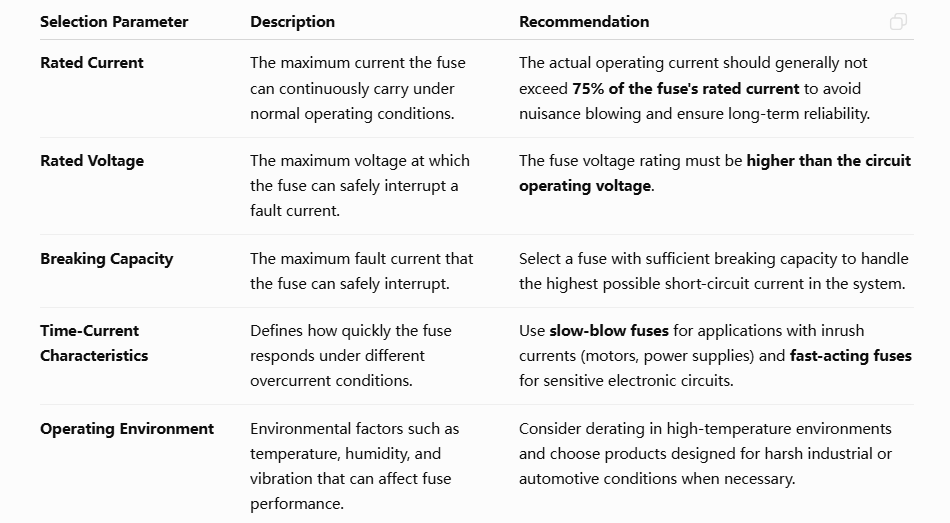
Notes: The greatest value of an fuse is not simply its melting, nor is it simply choosing a fuse with the same current rating. Rather, it is melting at the right time.
- If the action is too rapid, it will lead to false protection.
- If the action is too slow, it may not effectively protect the circuit.
The application of fuses in the new energy and AI era
The rapid development of new energy vehicles, storage systems, and AI servers has raised higher requirements for fuses.- AI server GPU power consumption exceeds 1000W
- Electric vehicle battery voltage reaches the 800V platform
- The current in the energy storage system keeps increasing
Development trends
The future development trends of fuses will focus on several main directions:- Miniaturization and high integration
- Higher interrupting capacity design
- New energy-specific fuses
- Automotive-grade fuse certification
- Intelligent monitoring and predictive maintenance
Related information


- Fast Shipping Fast and convenient door to door delivery.

- Paypment Security More than 5 different secure payment methods.

- Strictly Quality Control 365 days After-Sales Service and Warranty

- Simple And Professional One-stop Electronics Procurement Solutions.