Hello! now
 +8619886240609(Bella)
+8619886240609(Bella)
 My Account


Has the era of MLC come to an end?
3/31/2026 2:45:15 AM
MLC was once the ideal solution for balancing cost, capacity and lifespan, perfectly achieving the high reliability of SLC while maintaining the cost-effectiveness required for large-scale production. For over a decade, industrial and embedded system designers have relied heavily on MLC NAND flash memory. However, the storage landscape is constantly changing, and with the widespread adoption of 3D NAND and TLC/QLC technologies, the mainstream market for MLC has entered the era of "lifecycle end".
PSLC is not a performance decline; rather, it is becoming the "savior" of industrial storage, with reliability comparable to or even surpassing traditional MLC. PSLC (pseudo-SLC mode) simulates SLC using TLC/QLC, significantly increasing lifespan and approaching the reliability of MLC while being more cost-effective. However, its capacity is only 1/3 or 1/4.
As the market continues to compress the cost per unit capacity, NAND technology keeps evolving towards smaller nodes and higher stacking layers, and TLC (each cell 3 bits) gradually becomes the mainstream. Compared to MLC, TLC has more advantages in capacity and cost, and is therefore widely used in consumer devices.
However, in industrial scenarios, TLC also brings some issues that cannot be ignored:
1. Durability decreases.
The write/erase (P/E) cycle life of standard TLC is usually between 1,000 and 3,000 times. In continuous writing scenarios, such as 7×24-hour video recording or high-frequency data acquisition, this lifespan can easily become a system bottleneck. For embedded systems built with MCUs like STM32 or ATmega, if the main control design goal is long-term stable operation, then the durability of the storage device must match it.
2. Data retention capability decreases.
With the reduction in cell size and the increase in the number of storage voltage states, TLC is more sensitive to temperature. In high-temperature or complex environments, charge leakage is more likely to occur, which can trigger bit errors and lead to data reliability problems over the long term.
In this context, engineers often face a dilemma:
In practical applications, pSLC is usually implemented based on standard 3D TLC NAND. Through firmware configuration, the controller programs and manages each storage unit in a 1-bit manner, making it operate in a form similar to SLC.
Its core advantage comes from the change in the voltage determination mechanism.
In the TLC mode, each unit needs to represent 3 bits of data, corresponding to 8 different voltage states. The intervals between these states are small. In long-term use or in high-temperature environments, factors such as voltage drift and charge leakage are prone to causing misinterpretation, thereby generating bit errors.
Standard thin-film chromatography: approximately 3,000 P/E cycles.
Traditional MLC: ~3,000 - 10,000 P/E cycles.
pSLC: 20,000 to 30,000+ P/E cycles.
2. Excellent data retention capability and temperature resistance
pSLC has a large safety margin between voltage states, so it has stronger resistance to physical degradation caused by high temperatures. Even if high temperatures cause electron leakage, the controller can still accurately determine whether the unit represents 0 or 1. This significantly reduces the uncorrectable bit error rate.
3. Continuous write performance
pSLC hard drives usually provide higher continuous write speeds, avoiding the common "performance decline" phenomenon that occurs when TLC hard drives are filled with cache.
Suppose you make a unit designed to store 3-bit data only store 1 bit of data. Then you will sacrifice two-thirds of the storage capacity to achieve reliability.
Calculation method: If a 64GB TLC NAND chip is formatted into pSLC mode, the available capacity will drop to approximately 20GB to 22GB.
Cost: Therefore, the "cost per GB" of pSLC is higher than that of standard TLC.
In this context, pSLC provides a more feasible alternative path. It is based on TLC hardware and managed by the controller in 1-bit mode, achieving a balance between reliability and cost. Compared to native SLC, pSLC is cheaper; compared to traditional MLC, its durability and stability have more advantages in many applications.
For systems that require long-term stable operation, the reliability of the storage device is often more important than capacity. In scenarios such as in-vehicle infotainment, industrial control, or medical monitoring equipment, pSLC can improve the overall durability of the system without significantly increasing costs.
From practical indicators, the erasure life of standard TLC is usually between 1,000 and 3,000 times, while in pSLC mode, it can be increased to the order of 30,000 times. This improvement comes from a simpler voltage state determination, making the storage unit more stable in long-term use and complex environments.
From an engineering perspective, this is a typical trade-off: by reducing the effective storage capacity, higher reliability and longer lifespan are achieved. With the gradual exit of MLC, this trade-off is becoming the default choice in more and more designs.
The essence of MLC vs TLC vs QLC
MLC, TLC and QLC are three completely different technological routes: prioritizing performance and reliability VS prioritizing cost and capacityCore differences
- MLC: More stable, more durable, but more expensive
- TLC: Cost and performance balance
- QLC: Maximum capacity, lowest cost, but shortest lifespan
Key parameter comparison
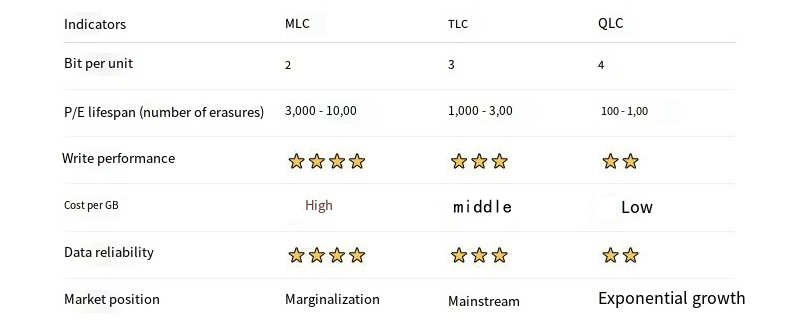
Technical Comparison
Storage Density vs. Reliability- MLC: 4 voltage states, easier to distinguish and more stable
- TLC: 8 voltage states
- QLC: 16 voltage states, highly susceptible to interference
- TLC/QLC: Suitable for scenarios with high capacity requirements and cost sensitivity such as consumer-grade SSDs and AI big data storage
- MLC: Suitable for scenarios with frequent writes and the need for long-term stable operation such as industrial control, automotive electronics, or medical equipment
The Evolution and Challenges from MLC to TLC
After the reduction of MLC, the industry did not collapse but instead emerged with an alternative strategy - PSLC (pseudo-SLC).PSLC is not a performance decline; rather, it is becoming the "savior" of industrial storage, with reliability comparable to or even surpassing traditional MLC. PSLC (pseudo-SLC mode) simulates SLC using TLC/QLC, significantly increasing lifespan and approaching the reliability of MLC while being more cost-effective. However, its capacity is only 1/3 or 1/4.
The technical background of PSLC
For a long time, MLC has been the mainstream choice for industrial-level storage, typically providing 3,000 to 10,000 programming/erasing (P/E) cycles, meeting the requirements of operating system storage and medium-intensity data recording, balancing reliability and cost requirements well.As the market continues to compress the cost per unit capacity, NAND technology keeps evolving towards smaller nodes and higher stacking layers, and TLC (each cell 3 bits) gradually becomes the mainstream. Compared to MLC, TLC has more advantages in capacity and cost, and is therefore widely used in consumer devices.
However, in industrial scenarios, TLC also brings some issues that cannot be ignored:
1. Durability decreases.
The write/erase (P/E) cycle life of standard TLC is usually between 1,000 and 3,000 times. In continuous writing scenarios, such as 7×24-hour video recording or high-frequency data acquisition, this lifespan can easily become a system bottleneck. For embedded systems built with MCUs like STM32 or ATmega, if the main control design goal is long-term stable operation, then the durability of the storage device must match it.
2. Data retention capability decreases.
With the reduction in cell size and the increase in the number of storage voltage states, TLC is more sensitive to temperature. In high-temperature or complex environments, charge leakage is more likely to occur, which can trigger bit errors and lead to data reliability problems over the long term.
In this context, engineers often face a dilemma:
- Use the more expensive and limited capacity SLC to obtain higher reliability.
- Use standard TLC but bear the risks of lifespan and stability.
The working principle of pSLC
pSLC is a working mode implemented based on the controller, essentially a usage method for existing flash memory.In practical applications, pSLC is usually implemented based on standard 3D TLC NAND. Through firmware configuration, the controller programs and manages each storage unit in a 1-bit manner, making it operate in a form similar to SLC.
Its core advantage comes from the change in the voltage determination mechanism.
In the TLC mode, each unit needs to represent 3 bits of data, corresponding to 8 different voltage states. The intervals between these states are small. In long-term use or in high-temperature environments, factors such as voltage drift and charge leakage are prone to causing misinterpretation, thereby generating bit errors.
In the pSLC mode, each unit only stores 1 bit of data, only needing to distinguish between two voltage states (0 and 1). Due to the significant reduction in the number of states, the voltage distribution intervals are significantly increased, making the interpretation process more stable.
This wider voltage margin (margin) makes the storage unit less sensitive to interference, including:
- Voltage drift
- Read interference
- Charge leakage
Advantages of pSLC
1. Durability comparable to MLCStandard thin-film chromatography: approximately 3,000 P/E cycles.
Traditional MLC: ~3,000 - 10,000 P/E cycles.
pSLC: 20,000 to 30,000+ P/E cycles.
2. Excellent data retention capability and temperature resistance
pSLC has a large safety margin between voltage states, so it has stronger resistance to physical degradation caused by high temperatures. Even if high temperatures cause electron leakage, the controller can still accurately determine whether the unit represents 0 or 1. This significantly reduces the uncorrectable bit error rate.
3. Continuous write performance
pSLC hard drives usually provide higher continuous write speeds, avoiding the common "performance decline" phenomenon that occurs when TLC hard drives are filled with cache.
How to Choose: Capacity and Reliability
Why is pSLC so powerful yet not everyone's first choice? It's because there is an inevitable trade-off between capacity and reliability.Suppose you make a unit designed to store 3-bit data only store 1 bit of data. Then you will sacrifice two-thirds of the storage capacity to achieve reliability.
Calculation method: If a 64GB TLC NAND chip is formatted into pSLC mode, the available capacity will drop to approximately 20GB to 22GB.
Cost: Therefore, the "cost per GB" of pSLC is higher than that of standard TLC.
Conclusion: pSLC becomes the practical solution.
The gradual exit of MLC is more a natural evolution driven by technology and cost rather than a sudden risk. As the original factory's production capacity shifts to higher-density TLC and QLC, the availability of MLC in the supply chain is decreasing, and related designs also need to be adjusted.In this context, pSLC provides a more feasible alternative path. It is based on TLC hardware and managed by the controller in 1-bit mode, achieving a balance between reliability and cost. Compared to native SLC, pSLC is cheaper; compared to traditional MLC, its durability and stability have more advantages in many applications.
For systems that require long-term stable operation, the reliability of the storage device is often more important than capacity. In scenarios such as in-vehicle infotainment, industrial control, or medical monitoring equipment, pSLC can improve the overall durability of the system without significantly increasing costs.
From practical indicators, the erasure life of standard TLC is usually between 1,000 and 3,000 times, while in pSLC mode, it can be increased to the order of 30,000 times. This improvement comes from a simpler voltage state determination, making the storage unit more stable in long-term use and complex environments.
From an engineering perspective, this is a typical trade-off: by reducing the effective storage capacity, higher reliability and longer lifespan are achieved. With the gradual exit of MLC, this trade-off is becoming the default choice in more and more designs.
Related information

- Fast Shipping Fast and convenient door to door delivery.

- Paypment Security More than 5 different secure payment methods.

- Strictly Quality Control 365 days After-Sales Service and Warranty

- Simple And Professional One-stop Electronics Procurement Solutions.