Hello! now
 +8619886240609(Bella)
+8619886240609(Bella)
 My Account


Is a flash relay still necessary in new energy vehicles?
3/17/2026 3:17:17 AM
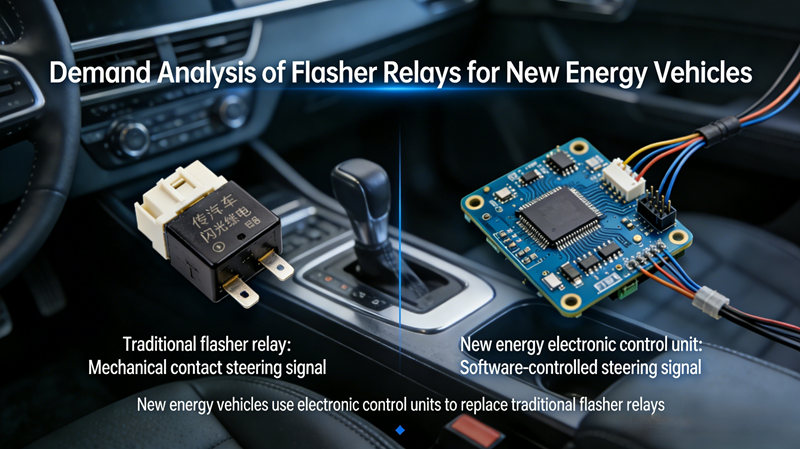
A flash relay is a control component that periodically connects and disconnects circuits to make lights flash at a fixed frequency. It is commonly used in scenarios such as car turn signals and hazard warning lights. Nowadays, with the advancement of technology and the emergence of new energy vehicles, the flash control function remains essential, but traditional mechanical flash relays have gradually been replaced, and integrated electronic control has become the mainstream solution.
Why do traditional cars need flash relays?
In traditional fuel vehicles, the flash relay, as an independent hardware controller, is mainly used to control the flashing of turn signals. Its core functions are:- Generating intermittent pulse current to control the flashing frequency, with a standard frequency of about 60-120 times per minute.
- Detecting whether the bulb is damaged through current changes.
- It is implemented through thermal effects or simple electronic circuits.
Why do traditional mechanical flash relays need to be replaced?
The elimination of mechanical flash relays is essentially due to the "mechanical era losing to the software era".1. The working principle is outdated.
Mechanical flash relays usually rely on bimetallic strips to bend due to heat, then through current heating - breaking - cooling - and reconnecting to form flashing. This exposes problems such as slow response, low precision, and susceptibility to environmental temperature.
2. Incompatible with LED lights.
Modern cars almost all use LED lights, but mechanical relays have a fatal problem: insufficient current, causing LED lights to not flash normally. The system misjudges the bulb as damaged, resulting in abnormal flashing frequencies such as rapid flashing or no flashing at all.
3. Short lifespan and low reliability.
The contacts of mechanical relays wear out and oxidize over time, leading to failure after prolonged use, and they have poor shock resistance. In contrast, electronic solutions have almost no mechanical wear.
4. Single function, unable to support intelligence.
Traditional flash relays can only achieve simple on or off flashing, but modern cars require functions such as dynamic light language, flowing turn signals, and ADAS system integration.
5. Inconsistent with the overall vehicle architecture trend.
New energy vehicles have characteristics such as integration, software-defined functions, and CAN/LIN communication control, which mechanical relays cannot achieve.
6. High energy consumption and low efficiency.
New energy vehicles are particularly sensitive to range, but mechanical relays rely on continuous current heating, leading to higher energy consumption.
7. Disadvantages in size and integration.
Mechanical relays are large in size and cannot be highly concentrated.
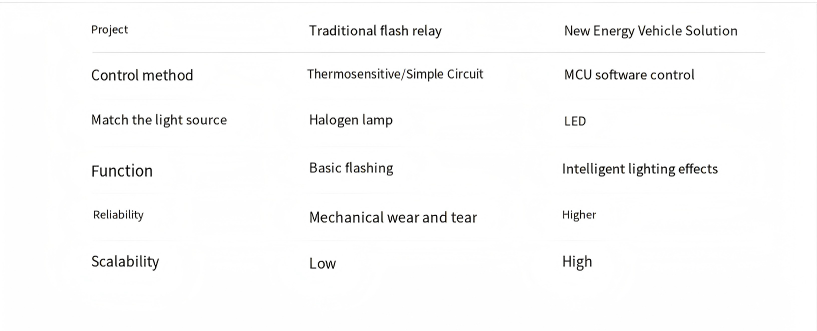
Technical Comparison
Summary
Relays are still used today, perhaps in some transitional models, in commercial vehicles or modified vehicles, or as redundant or protective circuits. However, in the context of rapid technological development, the replacement of flashing relays with software-defined lighting is an inevitable outcome. The function will shift from being implemented in hardware to being realized in control modules. Cars are evolving from discrete components to integrated control systems. New energy vehicles no longer rely on flashing relays, but the flashing control has never disappeared.Related information

- Fast Shipping Fast and convenient door to door delivery.

- Paypment Security More than 5 different secure payment methods.

- Strictly Quality Control 365 days After-Sales Service and Warranty

- Simple And Professional One-stop Electronics Procurement Solutions.