+8619886240609(Bella)
 My Account


The application of AI sensors in IoT devices
What is an AI sensor?
Introduction
AI sensors are a type of intelligent sensors that integrate artificial intelligence and sensing technology. They not only collect environmental data but also perform data processing, analysis and decision-making locally, ultimately achieving more efficient and intelligent data perception and application.
Composition
- Sensing unit: Collects physical or environmental information
- Data processing unit: Equipped with a built-in microcontroller or AI chip
- Storage unit: Stores collected data, AI models and algorithm parameters
- Communication module: Supports interfaces such as I²C, SPI, UART, Wi-Fi or Bluetooth to facilitate data transmission.
Main types
- Image AI sensor
- Voice AI sensor
- Motion AI sensor
- Environmental AI sensor
Working principle
- The workflow of the AI sensor is: data collection - data preprocessing - AI algorithm analysis - output result.
- The sensor detects environmental changes and collects raw data, such as sound, temperature, images, etc. Then, through filtering, noise reduction and signal conversion methods, the quality of the data is improved. The embedded AI model analyzes the data, and the system makes judgments based on the analysis results and outputs control signals and alarm information.
- In summary, AI sensor = data collection + AI analysis + intelligent decision-making
The integration of AI sensors with the Internet of Things
Status
In the Internet of Things (IoT) system, as the number of devices keeps increasing, relying solely on cloud computing will lead to high latency, heavy bandwidth pressure and privacy security issues. However, the emergence of AI sensors aims to solve these problems.AI sensors achieve edge computing by integrating AI algorithms on the device side, reducing data transmission volume, improving response speed, reducing system power consumption and enhancing data privacy protection. They are an important technical foundation of intelligent IoT.
Main applications in IoT
Smart home devicesSony IMX500 is a typical intelligent vision sensor with built-in AI processing capabilities. It adopts a stacked structure, combining the pixel chip and logic chip, and conducts image analysis and AI computing directly within the sensor.
- Its workflow is: collect image data --- run the AI model within the sensor --- output the recognition result
- Typical applications:
- Intelligent security cameras
- Intelligent traffic monitoring
- Intelligent retail systems
Industrial Internet of Things
AI sensors are used in the industrial Internet of Things for equipment status monitoring, predictive maintenance, and quality inspection. By analyzing data from vibration, sound, or temperature, the operating status of equipment is determined, potential faults are predicted and detected, significantly reducing downtime and thereby lowering maintenance costs.
Wearable Devices
Wearable devices are widely used in health monitoring and sports equipment, such as smart watches, fitness bands, and smart headphones. AI sensors are used to analyze human data in real time.
The Bosch BHI260AP is a typical intelligent motion sensor with integrated AI algorithms. It contains a 6-axis IMU and a 32-bit microcontroller, and can run learning algorithms within the sensor. It also supports various motion recognition functions, such as motion type recognition or direction and posture calculation, etc.
The differences from traditional sensors and their advantages in the Internet of Things
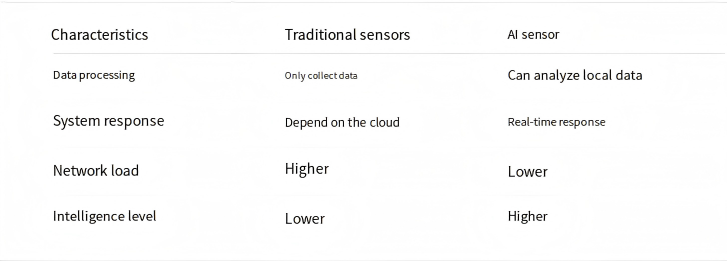
Development Trends
The application of AI sensors in the Internet of Things is gradually increasing, and its development trends include:- The popularization of edge AI technology: More sensors incorporate local AI computing capabilities
- Low power consumption design: Suitable for large-scale deployment of IoT devices
- Highly integrated chips: Integrating sensors, processors, and AI accelerators on the same chip
- Enhanced intelligence: Supporting more complex data analysis and decision-making functions
Summary
Sensors have begun to integrate AI computing capabilities. The emergence of AI sensors reduces reliance on cloud processing and enhances real-time performance, and is widely applicable to intelligent devices and automation systems. Intelligent sensor chips like Sony IMX500 and Bosch BHI260AP have been widely used in areas such as intelligent security, wearable devices, and industrial Internet of Things, driving the Internet of Things towards a more intelligent direction.Related information

- Fast Shipping Fast and convenient door to door delivery.

- Paypment Security More than 5 different secure payment methods.

- Strictly Quality Control 365 days After-Sales Service and Warranty

- Simple And Professional One-stop Electronics Procurement Solutions.